Introduction
I’m fully enjoying the fact that I don’t need to set foot on another airplane for another two months. Don’t get me wrong, I am fascinated by the airlines, but there’s only so much a man can take. So instead, I’m making the best of the gorgeous weather in Switzerland.
The start of this posts finds me ambling down the streets of Solothurn, Switzerland’s most baroque town. The Aare river snakes its way from Lake Biel past Solothurn and Aarau, to eventually merge into the Rhine halfway between Brugg and Baden.


First Leg: Solothurn to Biel
The first leg of the journey is up the Aare from Solothurn to Biel on the Siesta, which is a river-going vessel. There is an outside seating deck in the stern, and an inside deck with a restaurant in the bow.


I’ve booked ahead and made a reservation for breakfast for two. Our table is in the enclosed deck, which is good because it’s a very hot and sunny day. Luckily, the cabin is air conditioned. Included in the price of the breakfast is an orange juice and two hot drinks per person, butter, jam and cheese, bread rolls and croissants. Additional items can be ordered at an extra charge from the menu.


The journey from Solothurn to Biel takes two hours and forty minutes and it looks like I’ve picked the right day for the trip, because the weather is just lovely. Much to my surprise, though, the boat isn’t at all crowded.


The last part of the journey passes through a canal that links the Aare to Lake Biel. Originally, the river didn’t pass anywhere near the lake. The Hagneckkanal is eight kilometers long and includes one lock. It was constructed between 1875 and 1878 and was intended to put on end to the Aare flooding, which was, apparently, a regular occurrence.

I eventually arrive in the port of the city of Biel, from which the lake gets its name. Biel used to be at the centre of Western Switzerland’s watchmaking industry. Today, the town is still home to Omega Watches headquarters. Omega is the owner of Swatch. There is a museum of both brands on the factory grounds that is accessible to the public free of charge. So, before I continue my journey, I decide to make a quick detour to visit the museum.


Second Leg: Biel to St. Peter’s Island
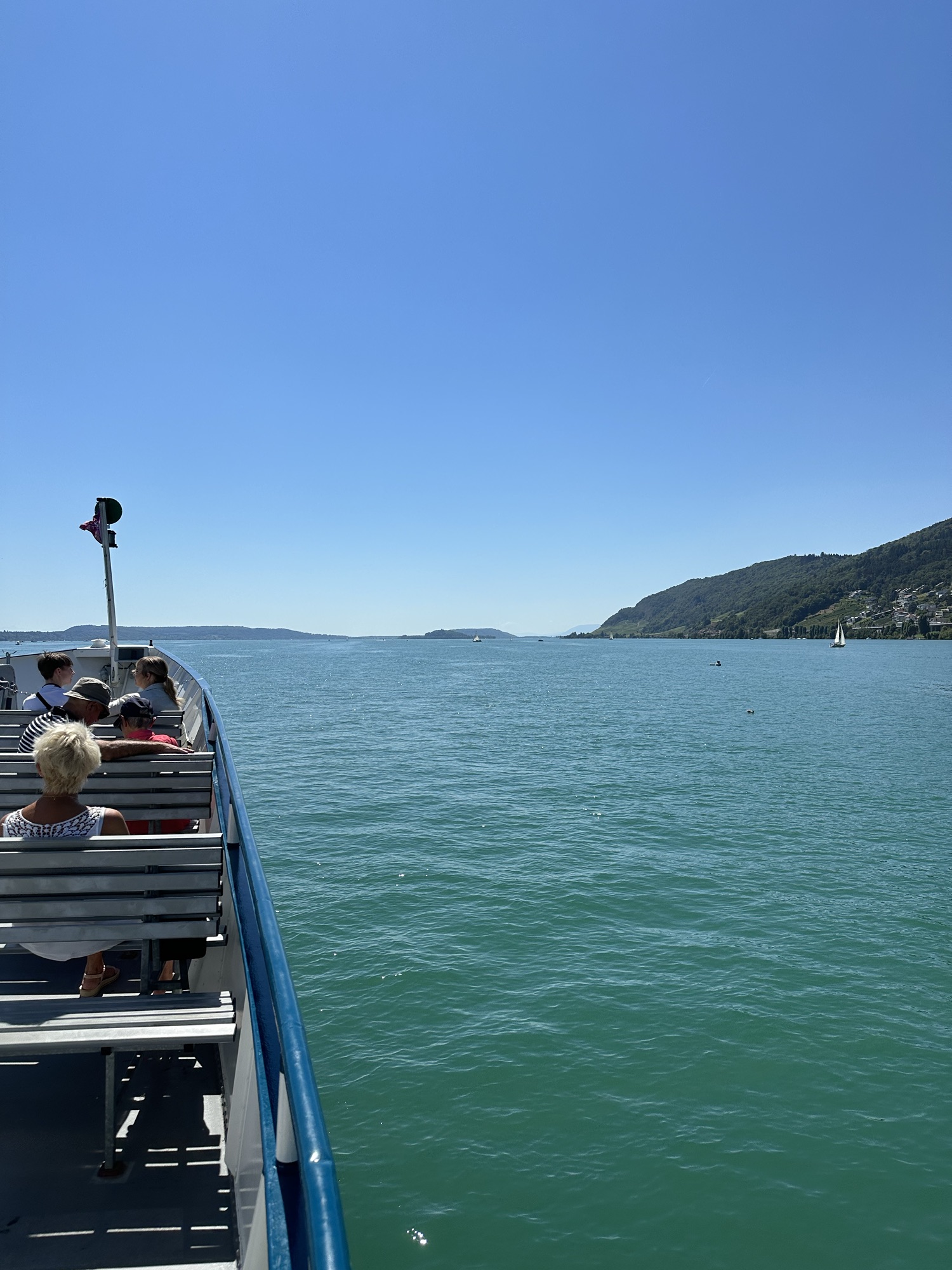
At 14h45 I return to the lake to catch the boat from Biel to St. Peter’s Island, which is a journey of about one hour. By the afternoon the temperature has gone above thirty degrees Celsius, and the pleasant breeze on the boat is deceiving. This is the kind of weather that can easily land you with a bad sunburn if you’re not careful.


Lake Biel is one of three lakes located in close proximity to each other in the Western part of Switzerland. They sit at the foot of the Jura mountains which separate Switzerland from France more or less down the full length of the country to Geneva. The mountains here are not so high and not as dramatic as the Alps, but certainly no less beautiful. The South facing hillsides make the region Switzerland’s primary wine-making region. Although to be honest (flame bait alert), I don’t really think that Swiss wines are generally that good.


At 15h35 the boat finally reaches St. Peter’s Island which, strictly speaking isn’t an island anymore. When the canals were built at the end of the 19th century, they caused the water level in the lakes to sink slightly. As a result, a think strip of land emerged that now connects the island to the town of Erlach on the mainland.

Access to the island is only by boat, by bike, or on foot. Cars are not permitted on the island. However, there is a shuttle that runs from Erlach.
Conclusion
The trip from Solothurn to St. Peter’s Island on the water is just so, so relaxing and exceptionally beautiful. Of course, it helps that I was really lucky with the weather. What is noticable on this trip is that there are hardly any foreign tourists on the boats, in Biel and on the island. They’re mostly locals. I guess, for foreigners this area may seem a bit off the beaten track, away from the classic Swiss tourist hotspots like Lucerne or Interlaken, which is perhaps why it is easily overlooked if you’re on an itinerary with limited time. Perhaps it’s also because the Jura range is a lot less dramatic than the Alps.
To conclude, I know that, strictly speaking, boats are slightly misplaced in the Trains category of this blog, but having a further category Land-Based-Means-Of-Transport-That-Are-Not-Trains simply doesn’t sound very sexy.