

Introduction
After I leave Antalya, my first stop is Istanbul, where I’ll be spending the night. My flight from Antalya arrives at noon, and my onward connection tomorrow morning departs at 08h00. None of that is an issue, if it weren’t for the fact that the airport is forty kilometres out of town and the journey from the centre of Istanbul to the airport can take you anywhere between 45 minutes and ninety minutes by car or bus. That is why, eventually, I decided to stay at the Yotel Landside and then just head into town for the afternoon.
Location
In terms of location, the Peninsula Istanbul must be, hands down, the best place I’ve ever enjoyed an afternoon tea. The Peninsula sits right on the water in Karaköy, close to the floating Galata bridge and the entrance to the Golden Horn and opposite the Sultanahmet peninsula – with the Topkapı Serai perched on a promontory overlooking the entrance to the Bosphorus.


It’s a warm, sunny day. So when the waitress suggests a table by the sea, of course I agree.

The Peninsula Istanbul Afternoon Tea
The Peninsula afternoon tea is a very elegant affair and served in the very traditional British style. They have a nice selection of excellent teas (which is hardly surprising – I’m in Turkey after all). The first tea I try is an Earl Grey, which is heavily perfumed and lovely. But then I try the Darjeeling and it blows me away. It has an infinitely subtle but still noticeable hint of saffron, and it’s outstanding. I don’t normally geek out about tea, but this one is stupendous!


For an amuse bouche, I am served a small tartelette of shrimp and celery and a tray with three savoury profiteroles with cheese.


The sandwiches are traditional. From left to right we have cucumber with mint, smoked salmon and crème fraîche, egg, and roast turkey. The sandwiches are all very nice.

As an intermezzo, chef brings out a marble cake that is served with crème diplomat and berries. And then out comes the étagère.

While I wait for the food to arrive, the waiter comes over to see if I’m okay. He asks me if this is my first visit to Istanbul, and I tell him I’ve been many times. The first time was 34 years ago when I was sixteen. I think this is the first time in my life I’ve literally made somebody’s jaw drop. He does the math and says, “but that would make you fifty”. When I don’t say anything, his eyes bug out and he starts apologizing profusely, explaining that he thought I was in my early forties. I laugh out loud and tell him there’s really no need for him to apologize.

At the bottom of the étagère are two warm scones. One is with raisins. The other is plain but with a subtle hint of rosemary, which is unusual but works very well. I should also like to point out that they actually serve the scones with real clotted cream! There’s also strawberry jam and lemon curd.


For the sweets I have a caramel biscuit (the round flat one), a raspberry tarte with matcha and pistachio cream, an orange and grapefruit tartelette and a chestnut cream.


I have to say, I very much enjoy this afternoon tea. Not only is the food exceptionally good, the service is impeccable and very friendly. And the location can hardly be topped. For me, sitting on the shore of the Bosphorus in the sun is pure and utter bliss!
An Afternoon in Istanbul
Before I have tea at The Peninsula, I have some time for sightseeing, and Istanbul is certainly a rewarding place to visit if you’re interested in history. I arrive in the heart of Istanbul at around 13h30. It’s a gorgeous sunny day. I love being on the sea, and so, as the first order of the afternoon, I catch one of the old passenger ferries from Karaköy to Kadıköy in Asia, on the other side of the Bosphorus. The journey takes about twenty minutes, and the views of the city are splendid. The boat make a brief stop in Eminönü, on the other side of the Golden Horn and in close proximity to the old Sirkeçı station, from where the Orient Express used to start its three day journey across Europe. Sadly, there are no more long-haul trains from here.


From Eminönü, the boat heads out into the Bosphorus, passing close to the Maiden’s Tower in the middle of the passage. It then turns south to pass along the inner side of the Üsküdar breakwater.
The building in the picture below is the old Haydarpaşa station. This used to be the terminus of the famed Taurus Express of the Hijaz railway, which travelled through Anatolia to Kirkuk and then on to Baghdad.

The arrival in Istanbul was timed to offer a good connection from the Taurus to the Orient Express. From the little kiosk in the photo below, just outside the main entrance to Haydarpaşa, passengers would board the ferry that would cross to Sirkeçı on the other side. They then had two hours to make the connection, which gave them enough time for dinner at the fabulous Tokatlıyan Hotel before they boarded the train.


Once I return to the European side, I head across the floating Galata bridge and past the many fishermen lined up on it. Sometimes there are so many of them that you begin to suspect there are probably more people fishing on the Galata bridge than there are fish in the murky water of the Golden Horn!

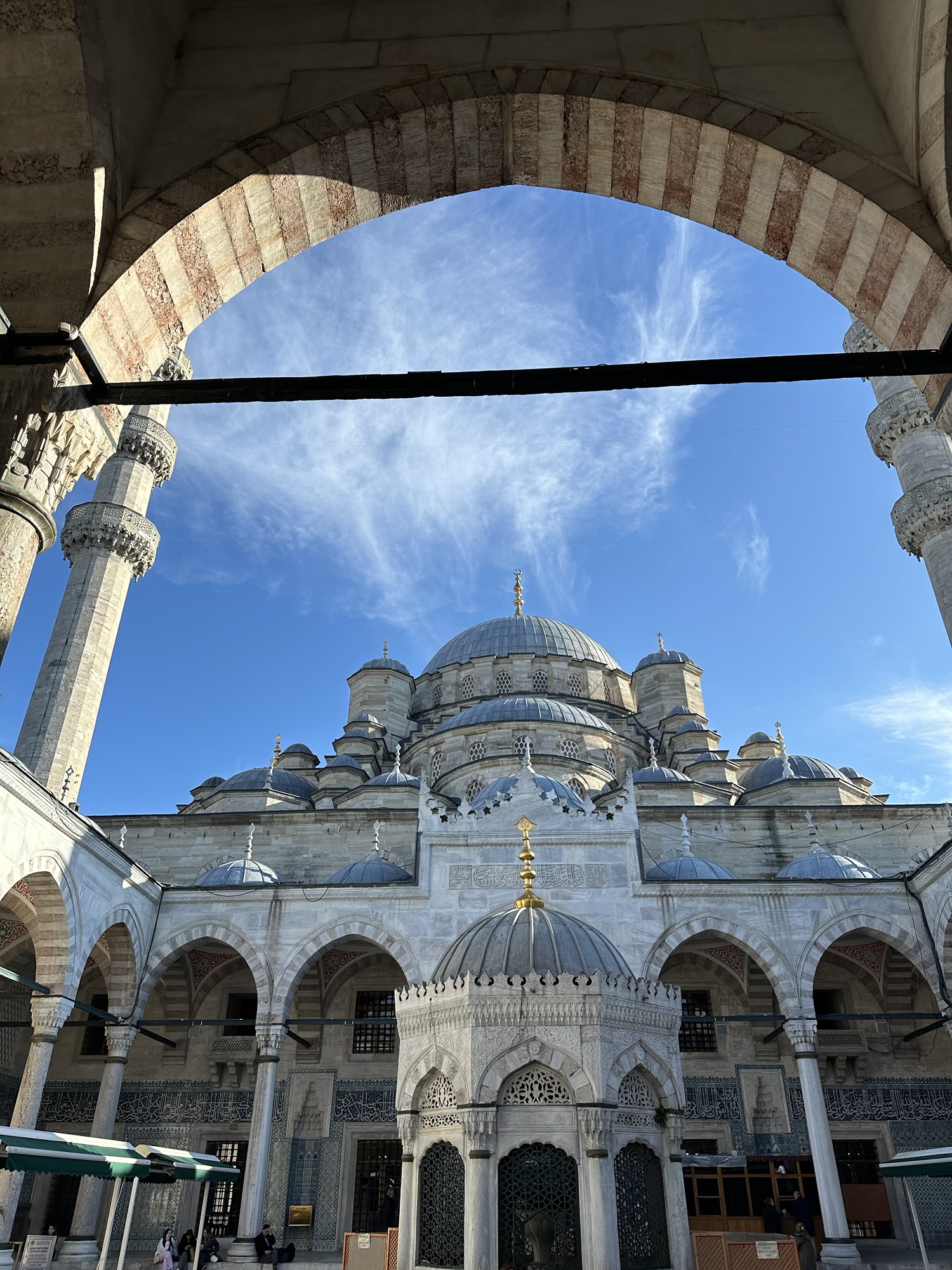
On the other side of the Galata bridge stands the New Mosque or Yeni Cami, which was commissioned by the mother of one of the Ottoman sultans. I step inside the sahn, the courtyard with its arcades, and just sit there enjoying the calm away from the bustling city outside. It’s so peaceful.


Right next to the New Mosque is the Souq al Misri, which is best known as the spice bazaar, but which was originally called the Egyptian market. Today, of course, it’s very touristy. But there are still a few spice dealers inside.
The photo below shows the tughra, the imperial seal of Süleyman the Magnificent, who is widely recognized as being one of the most important rulers of the Ottoman lineage, and whom the Maltese irreverently refer to a Barba Rossa. Süleyman was the terror of the Mediterranean sea. Under his rule, the empire experienced an extended period of relative stability, prosperity and rapid expansion. It is also because of him that the Knights of St. John’s of Jerusalem were initially forced to withdraw to Rhodes, until he hunted them down there too. The knights were eventually given Malta to protect as the last bastion of Christianity, the last line of defence to shield the Kingdom of Arragon from the onslaught of the advancing Turks. In 1565, Süleyman unsuccessfully laid siege to the Grand Harbour in Malta. Fortunately, he was unable to take the island. Fearing he was retreating only to gain strength before his next attack, Grand Master De la Vallette was tasked with the expansion and fortification of the capital city on Mount Sciberras, which would later take his name and become known as the City of Valletta. However, by the time the city was built, the Ottomans had moved up north through the Balkans, and were preparing to take Vienna. They never returned to make a second attempt to take Malta, and after their crushing defeat at Vienna the empire entered into a decline.

Conclusion
Istanbul is a brilliant place to visit. It’s not just the beautiful location on the Bosphorus and the Sea of Marmara. It also has a fascinating and rich history as the capital city of the Ottoman empire, which shaped southeastern Europe and the eastern Mediterranean.
Regarding the age thing—— i too quite often get accused of being a ‘Young man’——– Nice, but if only they knew!!!. This has been the best location for one of your almost legendary Afternoon Teas.The only thing that makes me feel a bit uneasy about Istanbul is that they are[from what i hear and read] overdue for a giant earthquake!
Hi Peter. The earthquake thing is a bit worrisome. But then again. A B 737 Max could fall on your head tomorrow.
Nothing wrong with people thinking you look younger than you are…
No, but the reaction was quite funny.