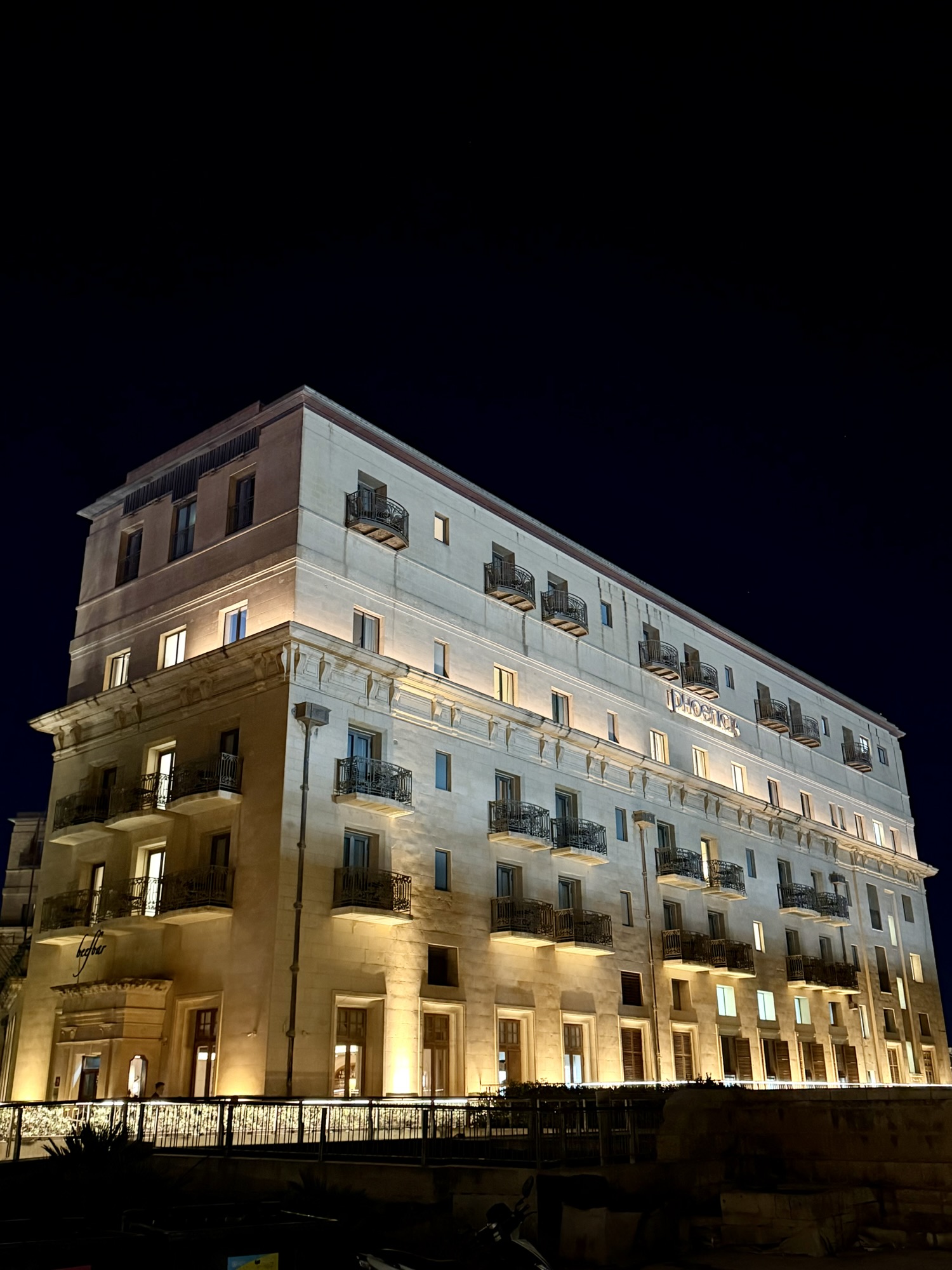

The Phoenicia at Valletta City Gate is currently Malta’s only property that is a member of the Leading Hotels of the World. The Phoenicia has a long and rich history that is closely linked to that of the island and the upheavals that eventually paved the way to Malta’s independence.
Location
The Phoenicia is located in a town called Floriana, which was established in the 18th century by Grandmaster de Vilhena. It is separated from Valletta by St. John’s Ditch and the bastions that circle Valletta. The Triton fountain sits opposite the hotel in its original spot, even though the rest of the square has completely changed over the years. What is now a sprawling pedestrian piazza was once the island’s main bus terminus. And it was such an eyesore. It was filthy, with black, greasy stains on the ground that had leaked from the ancient charabancs, and the air was rife with the smell of diesel exhaust and horse piss from the karozzini hoping to pick up (and rip off…) clueless tourists to take them up Duke of York Avenue to see the Auberge de Castille. But all of that is now far, far in the past.


Reception and Check-In
The reception area is off to the left of the main foyer as you enter the building. The friendly gentleman checking me in takes my credit card details and informs me that I’ve been upgraded to an Executive Room on the newly refurbished first floor because of my membership with the Leading Hotels of the World. He also reminds me that because of my membership, breakfast at La Contessa is complimentary as well.


The Phoenicia Staff & Service
In the old days, the staff at the hotel were all Maltese. Salaries on the island were so low that nobody in his right mind would consider moving to Malta for work. But that has changed in recent years, to the point that most of the staff working in the service and hospitality industry in Malta these days are no longer Maltese. The same goes for the Phoenicia. Most of the staff are from South Asia and the Philippines and, frankly, I think that’s a good thing because they are far more service oriented than the Maltese ever were, who tend to be a bit rough around the edges. It’s still nice that the few members of staff that have been with the hotel for a long time still recognise me and give me a warm welcome.
The Executive Room on the First Floor
The rooms on the first floor are the ones that were most recently renovated. They were only made available for reservations again at the beginning of 2026. I rather like what they’ve done with the rooms. I also think it’s nice that they have retained the original floor tiles with their classic and so typically Maltese design.
The door opens into a small foyer. This is where there are two large wardrobes, one of which also contains the safe. The bathroom is straight ahead. The room opens to the left. It’s not an overly big room, I’d say, but it’s certainly a comfortable size for two people sharing. The bed is large and has an excellent mattress that combines a soft surface with a firm core that provides perfect lumbar support.


The room has a good sized desk and a credenza with the tea and coffee making amenities and the bar.


The bathroom is just about the only thing they haven’t changed in this room. It features a bathtub instead of a walk-in shower. On the Knight of Malta Shower Test this sample scores in the mid-range. Pressure and temperature control are very good. However, you really have to pay very close attention to avoid making a huge mess on the bathroom floor and soaking the carpet in the process.
The cosmetics in the bathroom are by Acqua di Parma’s Arancia di Capri. It’s a lovely, refreshing scent that, in my view, really captures the essence of a Mediterranean summer by the sea.


Amenities
There are plenty of amenities in the room. First, there’s a welcome card with a small box of four traditional biscuits on the credenza. There’s a stylish but awfully bulky SMEG water kettle and an equally bulky SMEG coffee machine that uses Lavazza coffee capsules. The teas are by a company named Jing, which produces some truly excellent teas.


The snack bar contains alcoholic and non-alcoholic drinks and snacks – things like the fabulous Maltese Twistees or black truffle potato crisps. The soft drinks are complimentary.

In the wardrobe there are two bathrobes with slippers. In addition, there’s a SPA bar in the drawer of my nightstand which contains several creams and pastes of which I’m not fully sure what they’re supposed to do…


And then there’s also a nightly turndown service, when the room is prepared for the night – replenishing towels, restocking tea and coffee, closing the curtains, and placing a carton of water with a glass and a square of chocolate on the bedside table.

Dining Breakfast at La Contessa
There are several restaurants at the Phoenicia. Breakfast is served at La Contessa on the ground floor. The restaurant takes its name from the fact that Mabel Strickland, who commissioned the hotel, was the daughter of Sir and Lady Strickland, Count and Countess Della Catena. The restaurant has a sweeping terrace with a nice view of the sprawling hotel grounds and the bastions of Valletta in the background. The terrace faces North, which means that in the mornings it’s pleasantly calm and cool to sit outside before the heat makes it too unpleasant. The breakfast is a hot and cold buffet. Additional items can be ordered from the kitchen with the service staff, who are attentive and efficiently keep the place looking tidy.


The Pool Bistro in St. John’s Bastion
The hotel grounds include a sprawling garden that runs along the full length of St. John’s ditch and eventually leads to the pool area and bistro which have been built into the bastions overlooking Marsamxett harbour. The place usually gets busy in the afternoon, when the tourists return from a busy morning of sightseeing.


Afternoon Tea at the Palmcourt Lounge
And then, of course, there’s the Palmcourt Lounge. Actually, I’m not really sure if that’s what they still call it. So much has changed at the hotel recently. It makes no difference. For me it will always be the Palmcourt Lounge, where my mum would bring me for a drink on our way home form meeting my dad for lunch in Valletta.


The Palmcourt Lounge is where they serve the afternoon tea. There’s nothing extraordinary about it really, and that’s just what I like about this version of an afternoon tea. It’s an old-school affair with finger sandwiches served with a small salad on the side, plain and fruit scones with real clotted cream, and a selection of sweets, including the typically Maltese kannol, the cigar shaped pastry filled with ricotta and chocolate chunks.


Conclusion – The Phoenicia Valletta
This was another highly enjoyable stay at the Phoenicia at Valletta City Gate. The hotel holds a lot of memories from when we still lived in Malta. I think that is probably why it makes me so glad to see that the Phoenicia has been kept in such good condition over the years.

What a delightfully appointed hotel. I really like the pattern of the headboard above the bed as well as the tiles in the bathroom.
Also, I learnt a new word today: charabanc.
The Phoenicia is one of my favourites. The current manager is Australian and she’s certainly whipped the hotel into shape.
As for the word ‘charabanc’, Maltese uses a lot of fossil words that entered the language through English to refer to concepts that were introduced by the British – like public transport. The Maltese spelling, though, would be ‘Xarabank’.
Love that. The etymology of words is something that really interests me.
I’m not sure if you’ve been but the Royal Mansour Casablanca is worth a stay if you ever find yourself in the city. It’s the first hotel I’ve been to where I just wanted to move right in. So tastefully decorated and appointed, in quite a different style to the Marrakech sister property.
The Royal Mansour is just around the corner from the Sofitel in Casablanca. The last time I was there, I thought it looked rather nice when I walked past. I may have to visit twice more this year. I’ll consider it, thanks!
Thanks for the review!
> Salaries on the island were so low that nobody in his right mind would consider moving to Malta for work. But that has changed in recent years, to the point that most of the staff working in the service and hospitality industry in Malta these days are no longer Maltese. The same goes for the Phoenicia.
At this kind of hotel I would not expect this to make any difference though. A quick check shows over 800 euro per night, at that rate they should have the absolute best service staff in the industry no matter their ethnicity or salary requirements.
Looks like it’s still a lovely hotel overall. And sounds like the area around it was gentrified nicely.
Technically, he would be addressed as Lord Strickland, not Sir, since his barony outranks his knighthood (and even so, a knight is always addressed by his first name).
That tea service looked great too. Is that one of the better tea services offered in Malta?